
Projects leaded by:
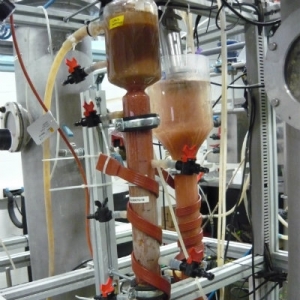
For the achievement of sustainable (energy-neutral or even energy-positive) wastewater treatment plants the use of Anammox for sewage treatment has been proposed. The performance of one-stage nitrogen removal of pretreated municipal nitrogenous wastewater has been tested with SBR as a first approach. In many of the studies, the known weak point of those trials is that nitrite-oxidizing bacteria (NOB) developed in the long term operation, triggering the production of nitrate, and decreasing importantly the N-removal performance with Anammox.
Granular biomass as an alternative of activated sludge for treating urban and industrial wastewaters
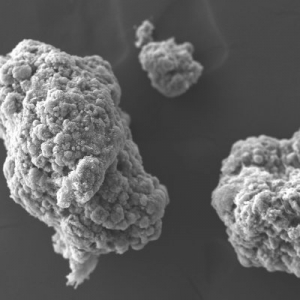
Aerobic granular sludge was developed as an alternative technology to conventional activated sludge processes for the treatment of wastewater. The morphological structure of aerobic granular sludge (i.e. high particle diameter and density) provides two main advantages if compared to activated sludge processes: (i) the ability of settling faster, which ease the retention of biomass; and (ii) the existence of substrate profiles across the granule radius, which allows simultaneous aerobic, anoxic and anaerobic processes into the same granule. Both characteristics contribute to reduce the required reactor capacity producing more compact designs, or to treat higher wastewater loading rates, when compared to conventional activated sludge systems. Furthermore, since aerobic granules can be separated from wastewater in the same reactor vessel, external settling units become unnecessary.
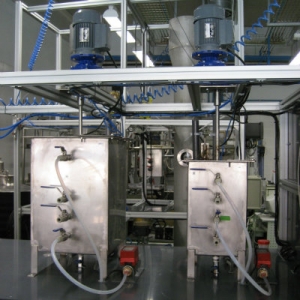
In this field we study different strategies to treat industrial wastewater contaminated with toxic or recalcitrant compounds by using advanced biological treatments (granular biomass for example), chemical oxidation processes or combined sequential chemical and biological processes.
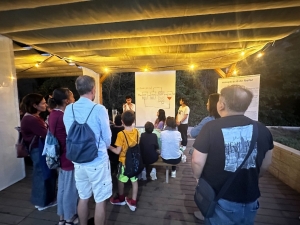
GENOCOV Research Group Shines at European Researchers' Night
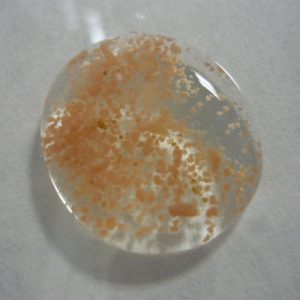
Several industrial processes such as petroleum refinement, coal tar processing, petrochemicals and resins production release wastewaters containing both, ammonium and phenolic compounds.
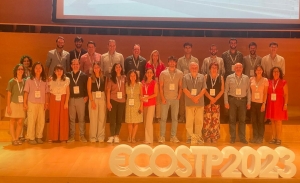
GENOCOV Research Group Shines at ECO STP 2023 Conference
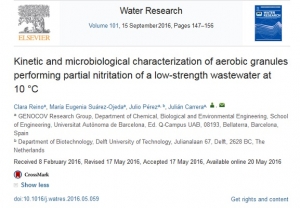
A new paper titled "Performance of microbial electrolysis cells with bioanodes grown at different external resistances" by Clara Reino, María Eugenia Suárez-Ojeda, Julio Pérez and Julián Carrera has been published in Water Research (2016), 101, 147–156.

The TRITON network welcomes you to its new website officially launched on April 29, 2016.

SAVING-E: Two-Stage Autotrophic N-remoVal for mainstream sewaGe trEatment. (LIFE14 ENV/ES/000633; 01/10/2015 - 30/04/2019). Julián Carrera Muyo (Coordinator). European Comission (1 165 306.00 Euros).